
Chinese hybrid canola spreads fragrance across Pakistan
WUHAN, Sept 12 (Gwadar Pro) –With the switch on, the canola spun rapidly in the press. Soon, a strong aroma filled the air. Watching the bright golden rapeseed oil flow into a barrel, Pakistani farmers all smiled with satisfaction.
Sayima Rizwan, a housewife from Gujranwala, praised the edible oil made from Chinese canola. “Now my family can’t live without it. With a reasonably price, this oil makes my dishes more fragrant.”
Wuhan Qingfa Hesheng Seed Co., Ltd. and EVYOL Group, a Pakistani agricultural enterprise, recently signed a memorandum of understanding (MoU) on canola industrialization cooperation. The two parties will further develop a comprehensive canola industry chain in Pakistan.
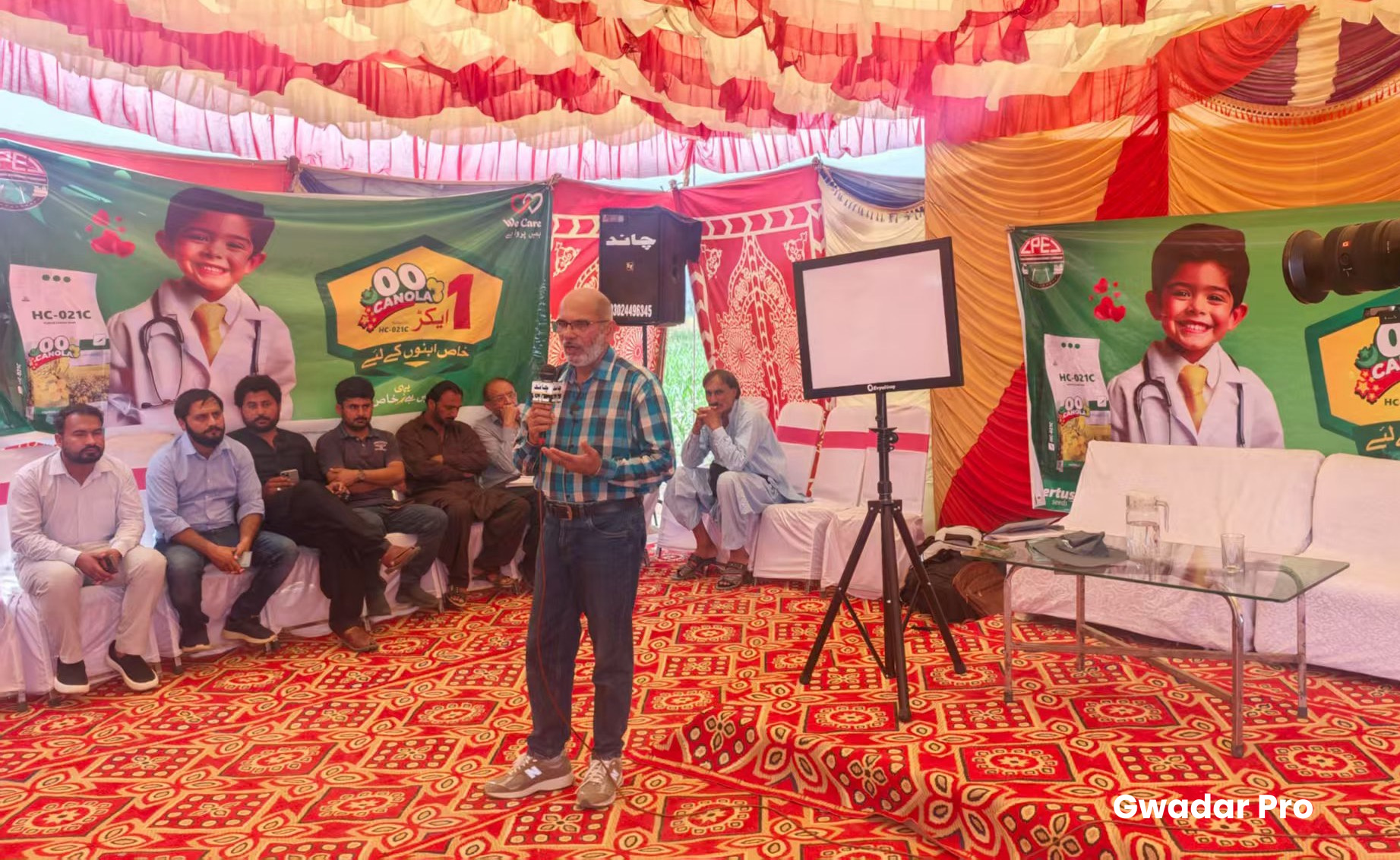
Qingfa Hesheng held a canola field training session in Pakistan [Photo provided to GP]
As one of the earliest Chinese seed companies to expand internationally, Qingfa Hesheng has been deeply engaged in the Pakistani market for 21 years. They discovered that Pakistan, a major consumer of edible oil, has an annual demand of 5 million tons, with 89% of which is imported, and annual cost is about USD 4 billion, resulting in an extremely low self-sufficiency rate.
“HC-021C, our low-erucic acid and low-glucosinolate hybrid canola variety, boasts an oil content exceeding 42% and an unsaturated fatty acid content exceeding 76%. Compared to local varieties, this represents an 8% increase in yield and a 6-8% increase in oil content,” said Zhou Xusheng, director of overseas business at Qingfa Hesheng in an interview with Gwadar Pro. “Low erucic acid means it’s more in line with modern healthy dietary needs. At the same time, the canola meal byproduct after extraction has a low glucosinolate content, into higher-quality feed, improving the overall benefits of local animal husbandry.”

Pakistani farmers use Chinese-made centrifugal oil filter [Photo provided to GP]
In recent years, Qingfa Hesheng has adopted an order-based production cooperation model to promote the planting of HC-021C on approximately 1.5 million mu (approximately 100,000 hectares) in the south Asia country, harvesting 250,000 tons of high-quality canola, equivalent to approximately 95,000 tons of edible oil, with a value of approximately USD 220 million.
“As Pakistan’s largest hybrid canola variety, HC-021C is expected to be promoted on an area of about 1 million mu (66666.7 hectares) in 2025-2026,” Zhou Zhanwang said.
“Our partnership with Chinese company ensures a stable supply of high-quality canola, which not only significantly reduces raw material and logistics costs, but also effectively increases the added value of end products. We’re going to undoubtedly plan to further expand our procurement scale in the future,” said Bashir, general manager of a Pakistani cooperative enterprise.
More than that, to adapt to local planting habits, Qingfa Hesheng independently developed two customized harvesting equipment to reduce canola losses and increase efficiency.
“We have established research and development farms in all canola promotion areas, providing systematic training for local technicians, and also introduced harvesting equipment, which could reduce harvest losses by nearly 30%. Besides, Chinese-made oil pressing equipment could also increase oil yield by about 10%, effectively helping farmers increase production and income,” Zhou introduced.
The reporter learned that the China-Pakistan Cooperation on the Promotion and Industrialization of New Hybrid Canola Varieties has been incorporated into the China-Pakistan Economic Corridor agricultural cooperation project. Qingfa Hesheng and EVYOL Group plan to further expand the application of hybrid canola within this framework by introducing the canola-cotton continuous cropping technology in Hubei Province, further expanding canola planting application in Pakistan.
Also, this breeding-planting-processing-sales full-chain model has been highly praised by Florence Rolle, the FAO Representative in Pakistan. “This technology transfer and industrial chain co-construction based on local needs provides a model for agricultural cooperation in developing countries.”